
Geography, at its core, is defined by the elements of location, terrain, and the extension of borders, be they coastal or inland. Yet, beyond this foundation, it also represents the dialogue between nature and human potential, reflecting how people engage with their environment—not only to overcome its challenges but to transform them into sources of strength and added value.
The Sultanate of Oman enjoys a highly strategic geographic position, which has long echoed in its policies, choices, and approach to various regional and global developments. 
Located in the far southeast of the Arabian Peninsula, the Sultanate of Oman lies between latitudes 16°39'N and 26°30'N, and longitudes 52°00'E and 59°50'E. It overlooks a 3,165-kilometre coastline stretching from the Arabian Sea and the gateway to the Indian Ocean in the southeast, to the Sea of Oman and ultimately Musandam Peninsula in the north, where it commands the strategic Strait of Hormuz—the entrance to the Arabian Gulf.
Oman shares land borders with the Republic of Yemen to the southwest, the Kingdom of Saudi Arabia to the west, and the United Arab Emirates to the north. The Sultanate of Oman also has several islands in the Sea of Oman and the Strait of Hormuz, such as “Salama Wa Banatiha” Salama and Her Daughters, as well as islands in the Arabian Sea, including Masirah Island and Al Hallaniyat Islands.
Straddling both sides of the Tropic of Cancer, the Sultanate of Oman is predominantly located within hot, arid zones, though its southern reaches are influenced by tropical climatic conditions. Thanks to this location, the Sultanate of Oman commands one of the oldest and most significant maritime trade routes in the world—the sea passage between the Arabian Gulf and the Indian Ocean. Land caravan routes across the Arabian Peninsula also converged here, connecting the western, eastern, northern, and southern parts of the region. The Sultanate of Oman covers a total area of 309,500 square kilometres.
The Sultanate of Oman’s terrain is marked by the Hajar Mountains, which stretch in a broad arc from the Musandam Peninsula in the northeast—home to the Strait of Hormuz—to Ras Al Hadd, the southeasternmost point of the Arabian Peninsula overlooking the Indian Ocean. The range reaches an elevation of 3,000 meters in Al Jabal Al Akhdar region. In Musandam, the mountains rise to around 1,800 meters above sea level. The Strait of Hormuz lies between the Omani and Iranian coasts, though the navigable section used for international shipping falls within the Omani side.
Locally, Omanis compare the Hajar Mountains to the human spine. The area facing the Sea of Oman is known as Al Batinah, while the region lying west of the mountains is called Al Dhahirah. Al Batinah is a coastal plain formed by valleys descending from the mountains, ranging in width from 15 to 80 kilometres and extending over 300 kilometres. This is Oman’s main agricultural region, rich in farms irrigated by groundwater. It stretches from Muscat in the north to the UAE border.
Numerous wadis cut through the mountain range, the largest being Wadi Samail, which links the capital, Muscat, with the interior Wilayats of Izki and Nizwa. The mountains west of this wadi form the Western Hajar range, home to Al Jabal Al Akhdar and towns such as Rustaq, Nakhal, and Al Awabi. To the east lies the Eastern Hajar range, encompassing towns such as Samail and Bidbid. Oman’s highest peak is Jabal Shams in Al Dakhiliyah Governorate, which rises approximately 3,000 meters above sea level.
Along the Muscat coastline near Qurum Heights, the shore narrows and becomes rocky, filled with inlets—a landscape that continues from southern Muscat to Ras Al Hadd. From Ras Al Hadd to Filim Beach in Masirah Bay lies Al Sharqiyah Sands, a vast area about 160 kilometres long and eight kilometres wide. To the southwest of Masirah Island lies a large expanse of flat, stony desert known as Jiddat Al Harasis, while to the west of Al Sharqiyah Sands stretches a broad, rocky plain roughly 250 kilometres wide, interspersed with north–south running wadis such as Wadi Hilfain and Wadi Andam.
West of Masirah Island lies the Barr Al Hakman Peninsula, separated by a 14-kilometre-wide channel. Barr Al Hakman is composed of salt flats, and during certain seasons, the sea covers up to five kilometres of its landmass. Its residents primarily rely on fishing for their livelihood.
Along the Arabian Sea, Oman’s coastline continues for 560 k ilometres through Al Wusta and Dhofar governorates. Around 130 kilometres of this stretch receive monsoon rains, supporting a coastal plain 8–10 kilometres wide that includes Salalah and other towns like Taqah, Mirbat, Sadah, Rakhyut, and Dhalkut. These coasts are rich in marine life, including shrimp, grouper, and sardines—the latter used for both animal feed and fertiliser.
The Dhofar Mountains stretch east to west for about 400 kilometres, from opposite Al Hallaniyat Islands to the border with the Republic of Yemen. The region features a continuous mountain range including Jabal Samhan in the east and Al Qamar Mountains in the west. The mountains are no wider than 23 kilometres, with the highest peak rising to 2,500 meters. For 75 kilometres of the range, greenery flourishes each year from June to September during the Khareef (monsoon) season. Unique in the Arabian Peninsula, this region experiences seasonal southwesterly monsoon winds that transform Dhofar into a lush summer retreat, rich in pastures and known for its historic frankincense trees. The trade of frankincense once formed the foundation of this region’s ancient wealth. The mountains also host natural springs that flow year-round.
Throughout history, the Sultanate of Oman has stood as a vibrant centre of civilisation, interacting actively with the cultural centres of the ancient world. It emerged as a powerful maritime and political force whose ships navigated the Indian Ocean toward the southern ports of Persia, the harbours of the Arabian Gulf, and up to Iraq. Their masts reached as far as the ports of East Africa, from northern Somalia down to Southern Mozambique.
The Sumerians referred to the Sultanate of Oman as "Majan" or "the Mountain of Copper," and this name appears in hundreds of Mesopotamian texts, both Sumerian and Akkadian, written in cuneiform. These texts highlight the strategic importance of the region and its natural wealth, especially copper and precious stones.
While historical accounts speak of various Arab tribes migrating to the Sultanate of Oman and settling there since ancient times, sources indicate that the first organised and significant migration was led by Mālik bin Fahm of the Azd tribes at the end of the first century CE.
With the rise of Islam, the Sultanate of Oman was among the first countries to embrace the religion willingly during the lifetime of the Prophet Muhammad, peace be upon him. The Prophet sent Amr ibn Al Aas to Jaifar and Abd, the sons of Al Julanda ibn Al Mustakbir, the ruling kings of Oman at the time, to invite them to Islam. The Sultanate of Oman responded positively under the leadership of the sons of Al Julanda and, from that moment, became one of Islam’s strongholds, contributing to its spread in many regions, particularly in East and Central Africa.
In the early years of the Islamic mission, the Sultanate of Oman played a significant role in the Wars of Apostasy (Ridda Wars) that followed the Prophet's death, and participated in major Islamic conquests, especially in Iraq, Persia, and the Indian subcontinent, in addition to contributing to the expansion into other territories within and beyond the region.
The Ya'aruba State is remembered not only in the annals of Omani history but also in the history of the Gulf and the Arab world at large. It succeeded in expelling the Portuguese from the coasts of the Sultanate of Oman, the Arabian Gulf, the Indian Ocean, and as far as East Africa.
Later, the Al Busaidi State, founded in 1744 by Imam Ahmad bin Said Al Busaidi and continued today by His Majesty Sultan Haitham bin Tarik – may God protect him – elevated the Sultanate of Oman into a major regional power. It built a vast Omani empire during the first half of the nineteenth century, extending across significant parts of East Africa. This empire asserted its naval dominance in the Indian Ocean and established balanced political relations with global powers.
Toward the end of the nineteenth century and the beginning of the twentieth, the Sultanate of Oman experienced periods of weakness, isolation, and internal conflict due to various local, regional, and international factors.
A new dawn broke with the emergence of the Omani Renaissance under the leadership of the late Sultan Qaboos bin Said bin Taimur who guided the nation through a period of modern revival. The Sultanate of Oman reclaimed its glorious past and regained a prominent position among nations.
The blessed journey continues under the wise leadership of His Majesty Sultan Haitham bin Tarik – may God protect him – who, upon assuming power on 11 January 2020, affirmed his commitment to continue the path of development and nation-building. His Majesty declared, “The Sultanate of Oman shall remain our highest and most sacred priority in all that we undertake and all that we strive to achieve. We call upon all citizens, without exception, to safeguard the gains of the blessed Renaissance and to participate actively in completing this triumphant journey, trusting in Almighty Allah and seeking His guidance and support.”
Opinions differ regarding the origin of the name “Oman.” Some trace it to the Qahtani tribe known as Oman, while others link it to meanings of settlement and permanence. Ibn Al-A'rabi stated that al-ʿumn refers to those who remain in a place, and the term Oman is derived from this root. He elaborates that “ʾaʿmana al-rajul” means “a man who remained settled in Oman.” On the other hand, Al-Zujjaji maintained that the Sultanate of Oman was named after Oman, the son of the Prophet Ibrahim Al Khalil, peace be upon him. Ibn Al-Kalbi offered a different perspective, suggesting that it was named after Oman bin Saba’ bin Yagthan bin Ibrahim Al Khalil –peace be upon him, who is said to have built the city of Oman.
Another account suggests that the Azd tribe named the region “Oman” after a valley in Ma’rib, Yemen, which was also called Oman and resembled their new settlement. Among the earliest Roman historians to mention Oman by this name was Pliny the Elder, who lived in the first century CE. He referred to a city called “Omana” in his writings. The name also appears in the works of Ptolemy, who lived in the second century CE. Scholar Grohmann believes that the “Omana” mentioned by both historians refers to the city of Sohar, which was considered the most important economic center in the region during the classical era. 
The Sultanate of Oman has also been known by other names throughout history. The Sumerians and the Mesopotamian civilizations referred to it as “Magan,” while the Persians called it “Mazoun.” This latter name is believed to derive from the word muzn, meaning raincloud or abundant flowing water. This likely reflects the early prosperity and agricultural development of the region, which enabled the establishment of a settled and thriving civilization.
In Arab sources, the name “Oman” appeared as an independent region. Both Al-Istakhri and Ibn Hawqal described it as a territory composed of autonomous districts governed by its own people. Ibn Khaldun was even more explicit in his description, listing Oman among the independent Arab regions on the Arabian Peninsula, alongside Yemen, the Hijaz, Hadhramaut, and Al-Shihr. He described its governance as “an independent sultanic domain.”
Regardless of these varying accounts, what is clear is that the name “Oman” dates back to ancient times and that the Sultanate of Oman has always borne a distinctly Arab identity since the earliest periods of history.
The message of Islam marked a pivotal turning point in the history of the Sultanate of Oman. The people of Oman responded to the Prophet Muhammad’s call with faith and peace, entering Islam voluntarily. Soon after, they played a pioneering role in solidifying the foundations of the new faith and spreading its teachings eastward and westward.
Historical accounts agree that Māzin bin Ghaḍūbah Al-Ṭāʾī Al-Samāʾilī was the first Omani to travel to Al-Madinah Al-Munawwarah and the first from the Sultanate of Oman to embrace Islam. When he met the Prophet Muhammad, peace be upon him, he said: “O son of the blessed and the pure, God has guided a people from Oman and granted them the blessing of your religion. Their land is now fertile, their trade has flourished, and fish are abundant.” To which the Prophet replied:
“My religion is the religion of Islam. God will bless the people of Oman with further fertility and abundance. Blessed is he who believed in me and saw me, and blessed is he who believed in me but did not see me. And even more blessed, again and again, is he who believed in me though neither saw me nor saw those who saw me. Verily, God will increase the people of Oman in faith.” 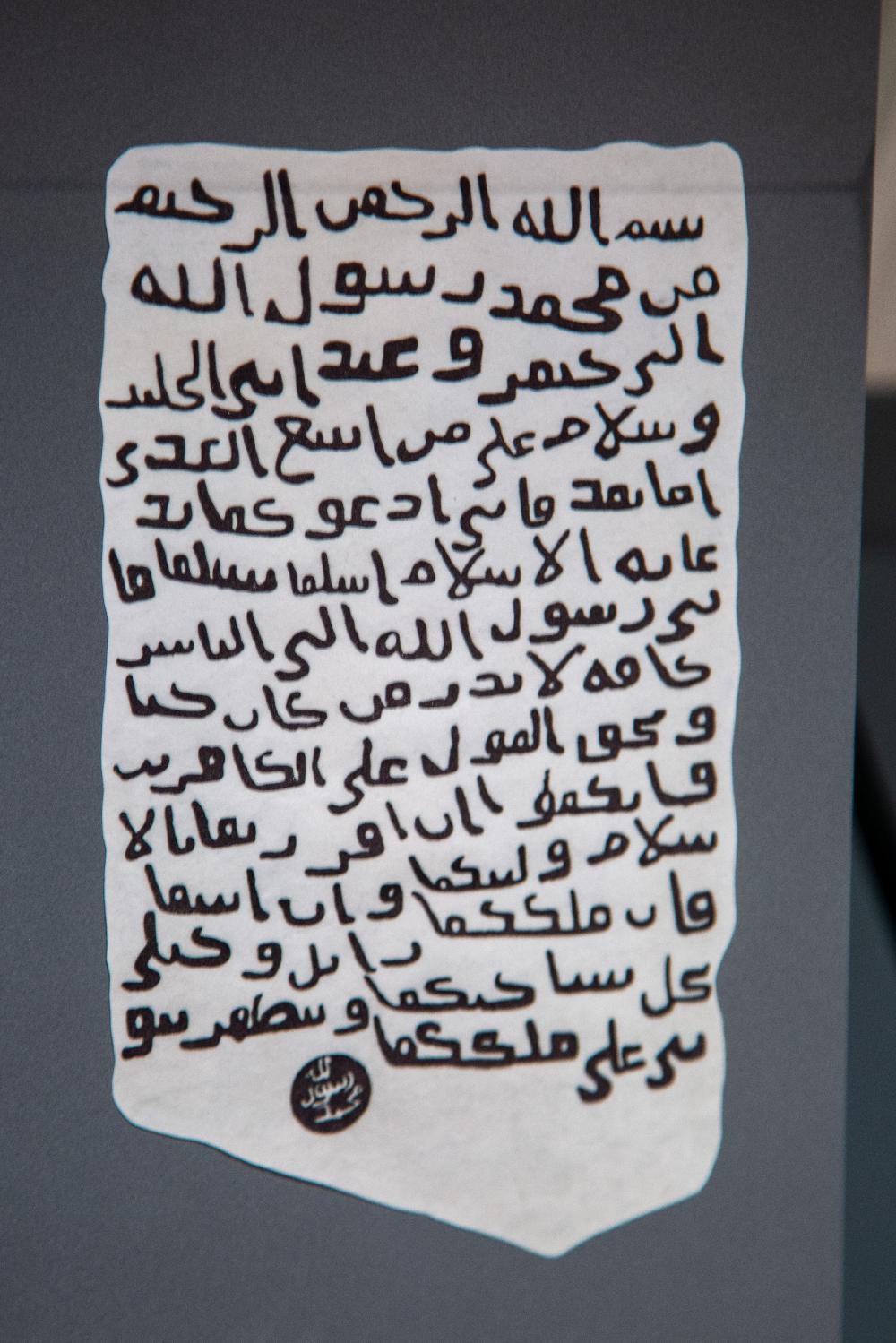
Indeed, the Sultanate of Oman was among the first nations to embrace Islam during the lifetime of the Prophet, peace be upon him. He sent ʿAmr bin Al-ʿĀṣ with a letter to the rulers of Oman at the time, Jaifar and ʿAbd, the sons of Al-Julanda bin Al-Mustakbir, inviting them to accept Islam. They responded positively, and Oman, under their leadership, entered the fold of Islam. From that time, the Sultanate of Oman became a stronghold of the faith, contributing to its spread in many regions, particularly in East and Central Africa.
This profound acceptance moved the Prophet, peace be upon him, to pray for the people of Oman, saying:
“May God have mercy on the people of Al-Ghubayrāʾ [a reference to Oman]; they believed in me though they did not see me.”
The Prophet’s praise and prayers for the people of Oman were a reflection of his knowledge of the sincerity and purity of their faith when their rulers embraced Islam wholeheartedly and without hesitation.
Abu Bakr Al-Ṣiddīq’s speech to the Omani delegation, led by ʿAbd bin Al-Julanda and attended by both Al Muhājirūn and Al Anṣār, stands as a powerful testament to the noble character, generosity, and steadfastness of the Omanis in embracing and upholding Islam.
The Sultanate of Oman played a prominent role in advancing the Islamic mission and participated actively in both land and sea conquests, especially in Iraq, Persia, the Indian subcontinent, and other regions. Omanis carried the message of Islam with them to East Africa, China, and to the ports of both Africa and Asia with which they engaged in trade and cultural exchange.
Today, Islam and its values remain a profound source of unity among the people of the Sultanate of Oman- values they uphold, cherish, and steadfastly embody.
Omani historians unanimously agree that the Nabahinah dynasty ruled the Sultanate of Oman for five centuries, across two distinct periods. The first is known as the era of the early Nabahinah, which lasted for four hundred years. It began following the death of Imam Abu Jabir Musa bin Abu Al-Maʿali Musa bin Najad in the year 549 AH / 1154 CE and ended with the fall of the reign of Sulayman bin Sulayman bin Muẓaffar Al Nabhani — the renowned poet-king — and the appointment of Muhammad bin Ismail as Imam of Oman in 906 AH / 1500 CE. This period was marked by numerous invasions and conflicts that challenged the Nabahinah both internally and externally, in addition to intermittent appointments of Imams. 
The second period, referred to as the era of the late Nabahinah, lasted from 906 AH to 1034 AH / 1500 to 1624 CE. It too was characterised by significant developments, including the appointment of Imams, internal power struggles within the Nabahinah dynasty, and rivalries between them and ambitious Omani tribes seeking authority. Among the most notable events of this era was the Portuguese occupation of Oman’s coastal regions.
It can be said that during certain phases, the Nabahinah’s influence was confined to the interior regions of the country. However, in many other periods, their authority extended to the coastal areas. At times, rebellious tribes managed to control parts of the coastline independently of central rule.
With regard to their relations with external powers, some Omani sources indicate that the Nabahinah maintained a range of foreign engagements, particularly political relations. These ties were most evident through diplomatic exchanges and visits with neighbouring countries — especially in the Gulf region, East Africa, and several Asian kingdoms.
While the Portuguese were consolidating their power by subduing regional forces and extending control over vast parts of the Omani coastline—despite fierce resistance from the people of Oman—the country was witnessing the dawn of a new era and the rise of new leadership. In 1624, Nasir bin Murshid emerged as the first Imam of the Yarubid State. He demonstrated a deep understanding of the issue at hand and was fully aware of the transformations taking place both within Oman and across the region. He realised that a decisive confrontation with the Portuguese could only succeed if supported by a united and cohesive national front—something that would require waging intense campaigns to unify the various Arab tribes. 
Imam Nasir bin Murshid succeeded in uniting the country under his leadership for the first time in many years. Through the establishment of a strong naval fleet, he was able to weaken Portuguese influence and liberate several coastal cities. The mission was then continued by Imam Sultan bin Saif, who pursued the Portuguese forces and ultimately succeeded in liberating Muscat in 1650.
The Omanis did not stop at expelling the Portuguese from their coasts. Instead, they launched a series of offensive campaigns against them across the Indian Ocean and East Africa. During the reign of Imam Saif bin Sultan, the foundations were laid for Oman’s renowned naval power, which came to dominate the entire East African coastline from Mombasa to Kilwa. As a result, Muscat became the principal trading hub of the Gulf region and one of the most important ports in the Indian Ocean and the Arabian Peninsula.
The accession of Imam Ahmad bin Said—who was then the governor of Sohar and its surrounding areas—in the year 1744 marked the beginning of a new era in the history of the Sultanate of Oman. This era has continued, in its various phases, for more than two hundred and seventy-three years to date. It is worth noting that the selection of Imam Ahmad bin Said as the leader of Oman came in response to the will of the influential decision-makers of the time, owing to his courage and decisive role in expelling foreign invaders, particularly the Persians. 
Under the leadership of Imam Ahmad bin Said, who laid the foundation for the Al Busaid State, the country witnessed—for the first time—a form of centralised authority following the unification of rival tribes. He initiated measures to establish the foundations of the state and to build an armed force capable of meeting the challenges facing the Sultanate of Oman. He also modernised economic activities, acquired a naval fleet for both warfare and trade, and maintained Muscat’s position as one of the most important commercial cities in the region. Its port became a key hub frequented by European vessels. Oman’s regional influence was revitalised during his reign, exemplified by the deployment in 1775 of a fleet of about one hundred ships—led by the massive vessel Al Turrad Al Rahmani—to the northern Gulf in support of the governor of Baghdad. The fleet succeeded in lifting the siege imposed by the Persians on the city of Basra.
Both Arab and European sources agree that several factors contributed to Oman’s emergence as a leading power, foremost among them the maritime and commercial expertise of its people. Omanis had accumulated vast experience over centuries, shaped by historical events, geography, and cultural heritage. Additionally, the political stability enjoyed by Oman and its ports—at a time when chaos prevailed in many other Gulf harbours—contributed to its rise. The personality of Ahmad bin Said himself was also a key factor. He was known for his discipline, decisiveness, and sound judgment. European powers respected him and trusted his policies, which attracted foreign merchants and led to the establishment of foreign trade agencies in Omani cities, especially in Muscat. By 1790, according to a report by the British East India Company, Muscat had become one of the most important cities in Asia.
Following the death of Imam Ahmad bin Said in Rustaq, which was the capital, in 1775 / 1189 AH, several distinguished Imams and Sultans succeeded him, preserving the rule of the Al Busaid dynasty. During the reign of his grandson, Hamad bin Said (1779–1792), the capital was moved from Rustaq to Muscat, where it remains to this day. It is well known that Omanis have long possessed a deep sense of national unity, bound together by shared loyalty to their land and mutual support in the face of external challenges. The continuity of Al Busaid rule from the mid-eighteenth century to the present day has further reinforced Omani national unity, particularly during key historical periods such as the reign of Sayyid Said bin Sultan (1807–1856) and that of the Late Sultan Qaboos bin Said bin Taimour, the architect of the Sultanate Oman.
Despite passing through certain periods of weakness and contraction, this enduring historical era has yielded numerous milestones in Oman’s national journey. Among the most significant are the complete elimination of foreign occupation and influence, the establishment of a vast Omani empire in East Africa during the first half of the nineteenth century, the assertion of Oman's maritime power across the Indian Ocean, and the forging of balanced political relations with global powers such as Britain, France, and the United States. The dynasty also succeeded in overcoming internal and regional challenges, laying the foundations for strong and balanced relations within the Gulf region and beyond, thus enabling the Sultanate of Oman to safeguard its national interests. Furthermore, a prosperous and modern state was built—one that embraces all its citizens equally and ensures their full rights of citizenship. Above all, this era has ensured the continuity and unity of Omani history, while reviving the glory of the Sultanate of Oman and reaffirming its enduring cultural contribution.